Repository navigation
fix(types): type CSS custom properties against what both platforms honour - #423
YevheniiKotyrlo wants to merge 4 commits into
Conversation


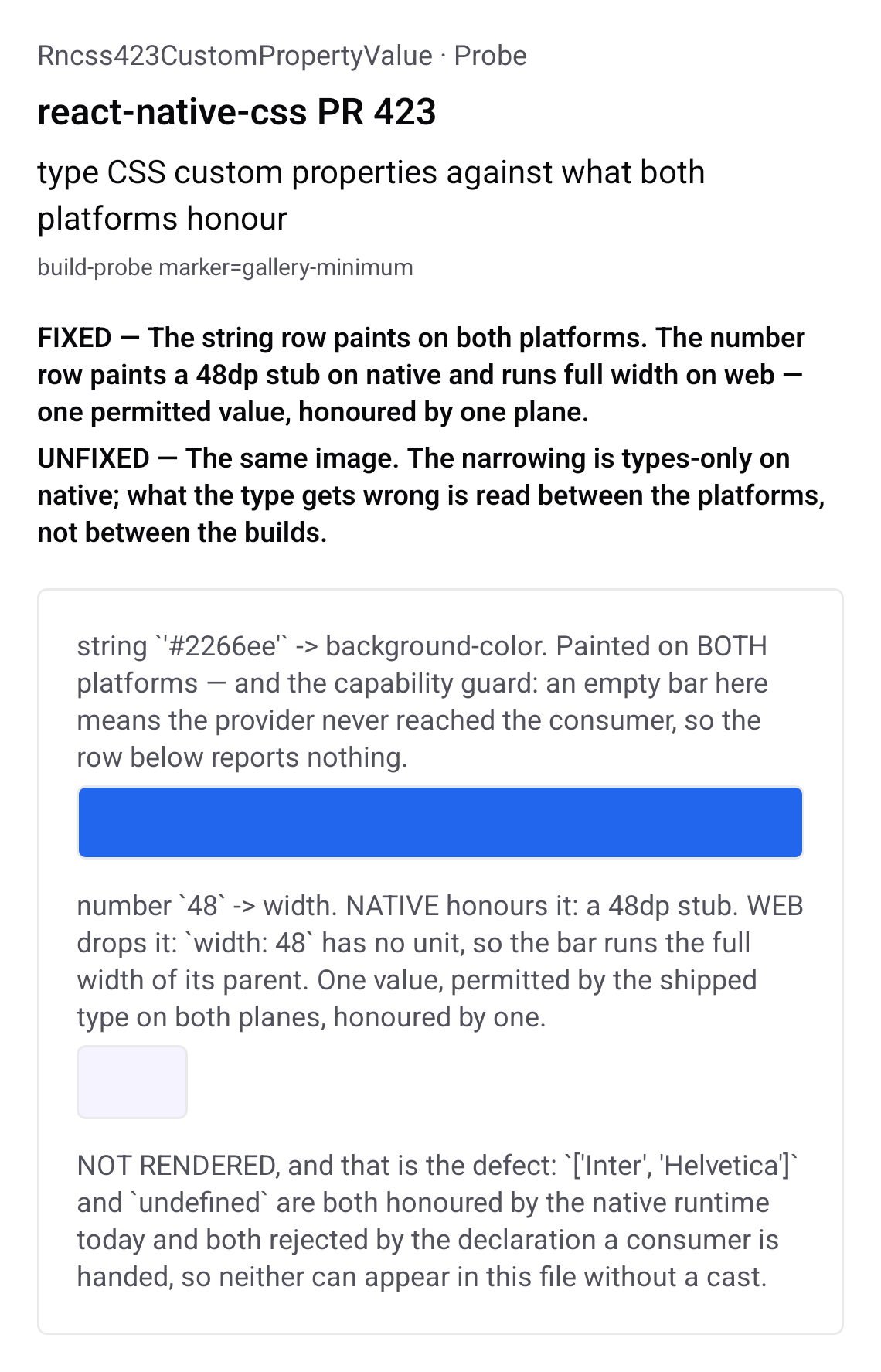
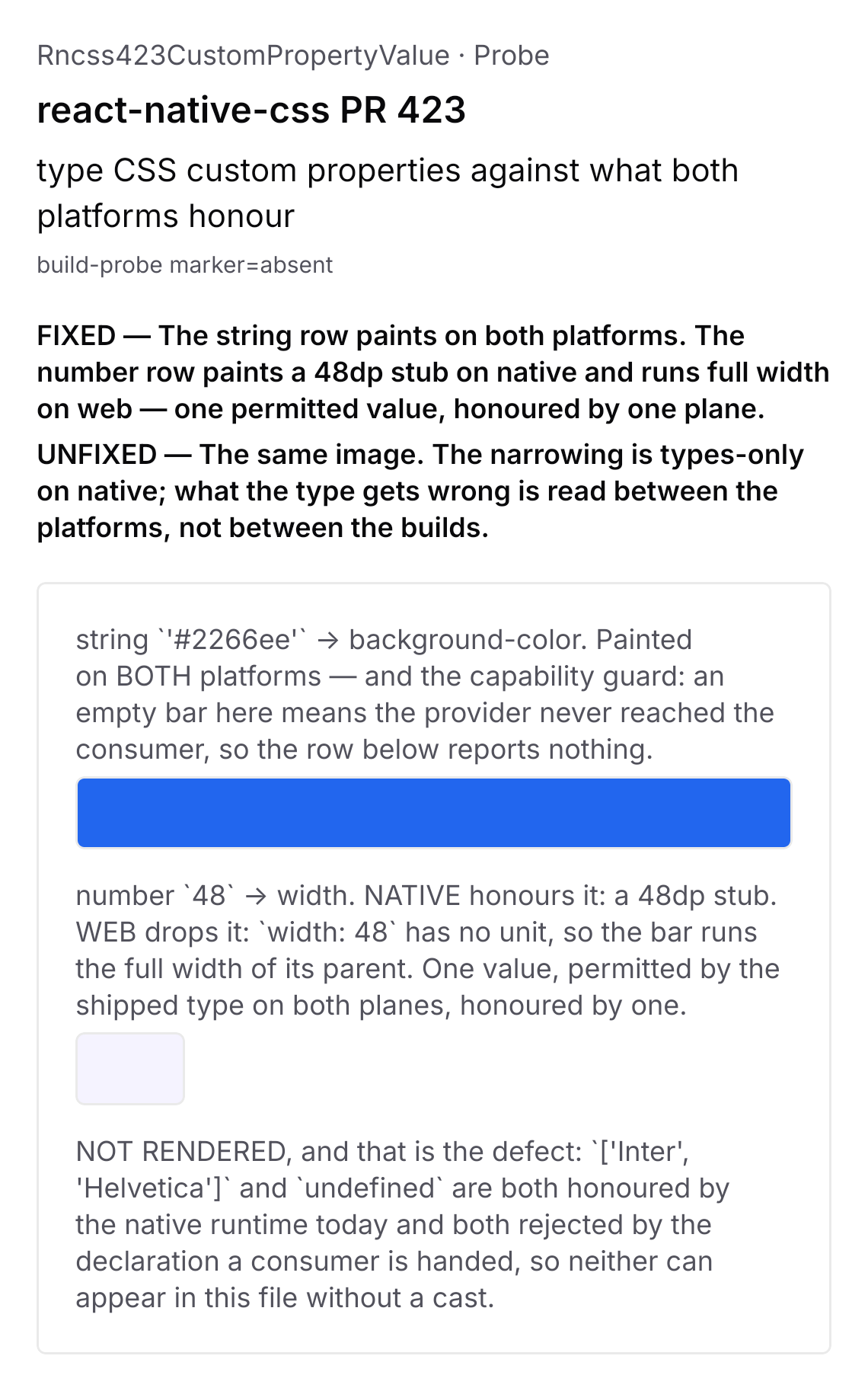
Device evidence — before / afterUNFIXED — The same image. The narrowing is types-only on native; what the type gets wrong is read between the platforms, not between the builds. FIXED — The string row paints on both platforms. The number row paints a 48dp stub on native and runs full width on web — one permitted value, honoured by one plane.
Apart from the typeface, the two frames are the same image: the change is to the declarations. Android 16 emulator (API 36, GLES on the host GPU), 1140×2400 @ 480dpi, both frames from one run. |
vars() and <VariableContextProvider /> mapped every entry of the record
they are given into the runtime's variable record, so an entry whose value
is undefined planted a key holding undefined. Variable lookup is
presence-keyed, so that key read as "set to nothing" and stopped the cascade
before the inherited value, the :root value and the var() fallback.

Both channels now build the record through toVariableRecord, which strips
the -- prefix and skips an entry with no value, the invariant the compiler
already holds. "unset" remains how a variable is deliberately cleared.
…nour

vars() and VariableContextProvider were typed Record<string, string | number>
on web and Record<string, StyleDescriptor> on native, and a consumer only
sees the web declarations, since the root entry's types re-export ./web. A
font-family list or an undefined entry was a type error though native takes
both, while StyleDescriptor admits var() tuples and null that web cannot
serialise: web's vars() threw on undefined and null, and its provider passed
raw values into the style.

CustomPropertyValue is the set both platforms honour: a string, a number, a
boolean, undefined, or an array of those, which is a comma-separated list.
Both platforms type vars() and VariableContextProvider with it, and web
serialises through one function that leaves an undefined value unset. A
type-level fixture holds the three entries to one type, and the README shows
the provider by its current name.

151b46c to
84c1f23
Compare
The case compiled with the default options, so the compiler inlined the
class's --color into the rule reading it and the result never depended
on how the runtime treats an undefined entry. It now keeps the
variable, so the class's value reaches the element only because an
undefined entry plants no key, and writes the colour as a hex with no
name, so both paths serialise it alike.
This branch has not been deployed
1 participant

Problem
vars()and<VariableContextProvider />are typed twice, and neither type is the set of values both implementations honour:Record<string, string | number>.Record<string, StyleDescriptor>.A consumer only ever sees the web types, because the root entry's declarations re-export
./weband nothing selects the native ones.vars({ "--font-stack": ["Inter", "Helvetica"] })andvars({ "--color": undefined })are type errors, though native honours both. Insrc/__tests__/native/vars.test.tsx, jest resolves the native runtime andtscthe web types, so the same file passes under one and fails under the other.StyleDescriptoradmitsundefined,nulland the compiler'svar()tuples. Onmain, web'svars()throws onundefinedandnull, and stringifies a tuple as[object Object],var,y.<div>'s style.Solution
CustomPropertyValueis the set both platforms honour: a string, a number, a boolean,undefined, or an array of those, which is a comma-separated list.vars()andVariableContextProviderwith it.undefinedvalue unset and drops anundefinedlist member.Tests
src/__tests__/_custom-property-value.types.tsis type-level and runs underyarn typecheck:null, an object, avar()tuple and the wholeStyleDescriptorare rejected.src/__tests__/web/variables.test.tsx: web serialisation of lists, booleans andundefined, throughvars()and the provider.src/__tests__/native/vars.test.tsx: a list and anundefinedvalue reach the native runtime as typed. Theundefinedcase keeps its variable (inlineVariables: false), so the class's value reaches the element only because anundefinedentry plants no key.main, 4 of the 5 web cases fail, and the native cases fail undertsc. Each of 4 mutations fails its own cases, and addingnullto the type fails the typecheck.Verification
On Ubuntu with the workflow's steps - build, lint, typecheck,
yarn test,node --test node/__tests__/*.mjs, both library builds, the web export, the unstaged-changes checks and commitlint - everything passes.Device evidence, before and after: #423 (comment)
Merge order
This carries #431, which makes an
undefinedentry plant no key on native — the native half of what this type promises — so #431 lands first.It also shares lines with #412 (
__tests__/native/vars.test.tsx,native-internal/variables.tsx), #443 (__tests__/native/vars.test.tsx), #469 (__tests__/native/vars.test.tsx); whichever lands second rebases.Base
Re-written on
main(a5002c5), where nativevars()declares itsViewStylereturn, which this keeps.